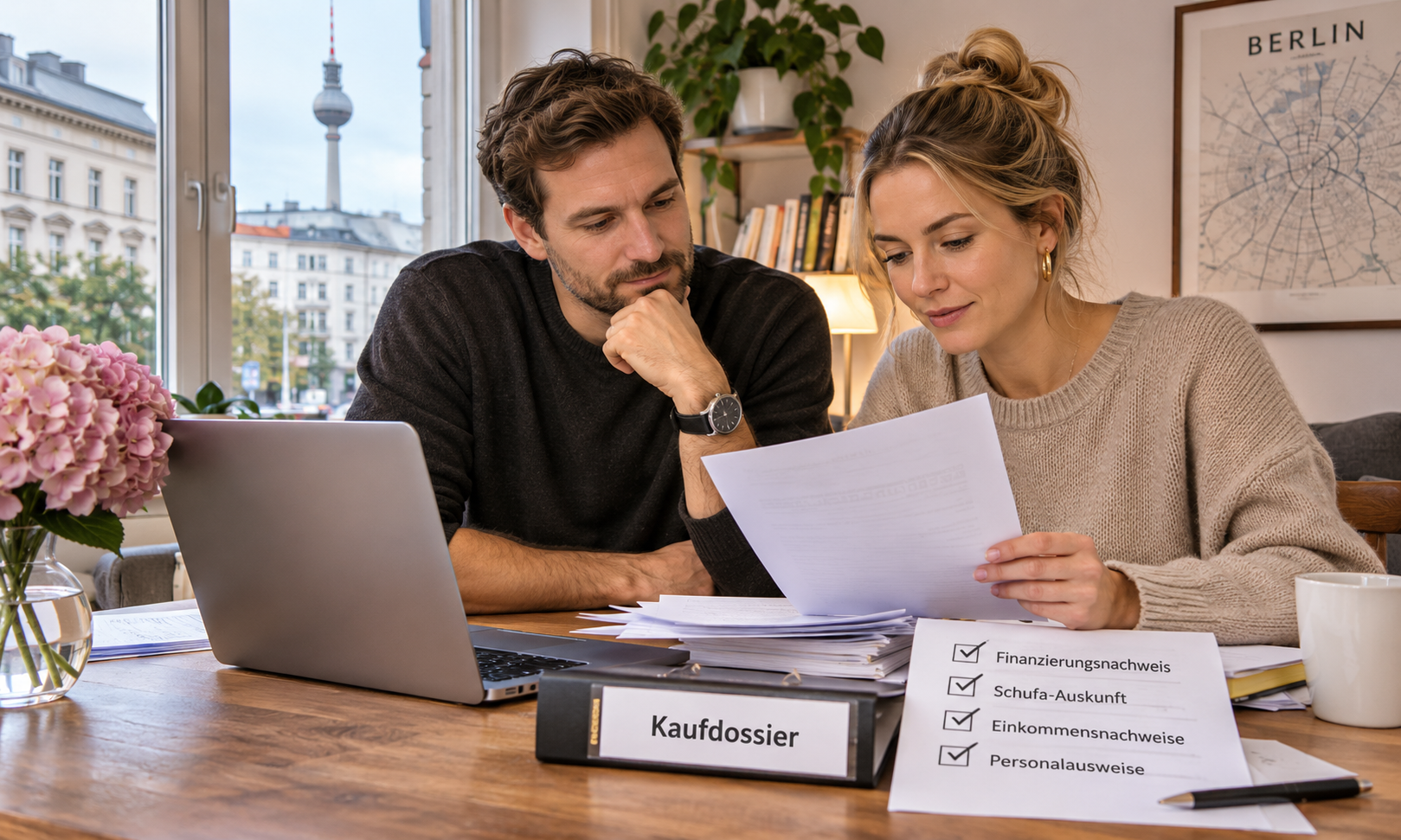
If there's one thing I'd tell every buyer before they start viewing, it's this: get your paperwork ready first.
Buying in Berlin is safe and well regulated, but it runs on documents. Your bank needs them before it will lend. The seller's documents need to reach your bank before your financing can be approved. And the notary needs a set of its own before a contract can be drafted.
Buyers who have everything in order move quickly when the right apartment comes along. Buyers who don't can lose it while they're still gathering payslips.
Here's every document you'll need, who asks for it and when.
The Short Answer
To buy an apartment in Berlin, you'll typically need:
For your bank: ID, the bank's financial disclosure form, recent payslips or tax documents, bank statements and proof of your own capital
About the apartment: the land register extract, the declaration of division, floor plans, the energy certificate, the annual budget and recent owners' meeting minutes
For the notary: your ID and German tax ID number, plus the apartment documents
The details matter, so let's go through each one.
1. Documents for Your Bank
This is the biggest pile, and the one to start first. Exactly what's needed varies from lender to lender, so treat this as a guide and check with your finance advisor.
If you're employed
A typical application includes:
Your passport or ID
The bank's financial disclosure form (Selbstauskunft)
Your last three payslips
Your latest annual wage tax certificate (Lohnsteuerbescheinigung)
Statements from the account your salary is paid into
Proof of your savings or other own funds
Details of any existing loans
Keep your employment contract to hand too, especially if you've recently started a new job or are on a fixed-term contract.
If you're self-employed
Alongside your tax returns, banks will want your official tax assessment notices (Einkommensteuerbescheide) for the same years. They'll typically ask for two to three years of annual accounts, or income-surplus statements (EÜR) if that's how you do your accounting, plus a current business performance report (BWA).
Depending on the lender and how your business is set up, they may also ask for a trial balance, business account statements, a commercial register extract or your company agreement.
Proof of your own capital
Banks want to see where your deposit and purchase costs are coming from.
| Source | What To Show |
|---|---|
| Savings | A recent official bank statement showing the account holder, date and available balance |
| Money from family | For a gift, a signed confirmation of the amount and that it doesn't need to be repaid. A family loan that does need repaying must be declared as a liability |
| A foreign bank account | A recent statement showing ownership, balance and currency. Check first that your lender accepts funds from that country |
| Investments | A recent brokerage or custody statement. Ask how much of the value the bank will count, and whether you need to sell before you buy |
Lenders differ a lot on money held abroad, so confirm before you rely on it.
SCHUFA and a short credit history
The SCHUFA, Germany's credit reference, is a standard part of every bank's assessment. If you've only recently arrived in Germany, there may simply not be enough data for a score.
That doesn't rule you out. Ask whether the lender can assess you on your employment contract, payslips, salary payments and proof of own funds instead. Some lenders will also consider a credit report from your home country, but check before you pay for one.
Documents in English
This depends on the lender and the document. Some accept English for certain evidence, while others need a certified German translation of foreign payslips, tax assessments or bank statements.
Before you order any translations, send your lender a list of your documents and ask which ones need translating. It can save you both time and money.
Non-EU buyers and residence permits
Both the type of residence permit and how long it has left can affect which banks will lend, how much and what they ask for. A permanent settlement permit (Niederlassungserlaubnis) opens up the most options. Financing is also possible with an EU Blue Card or another work permit, although some lenders may ask for more own capital.
If your permit is close to expiry, ask the bank whether it will accept proof of a pending renewal.
2. Documents About the Apartment
Here's something many buyers don't realise: your financing can't be approved until the bank has the apartment's documents too. That's why we gather the full set before a property goes on the market.
As standard, we provide:
The land register extract (Grundbuchauszug)
The declaration of division, with all amendments (Teilungserklärung)
The partition plans (Abgeschlossenheitsbescheinigung)
The energy certificate (Energieausweis)
The current annual budget for the apartment (Wirtschaftsplan)
Minutes from the last two to three owners' meetings (WEG-Protokolle)
The cellar allocation (Kellerzuordnung)
The current level of the building's maintenance fund (Instandhaltungsrücklage)
The living space calculation and floor plan, where available
Two questions are always worth asking on top. First, how much is currently saved in the building's maintenance fund? Second, does any single owner hold a majority share in the building? A majority owner can carry a lot of weight in decisions at owners' meetings, so it's good to know before you buy.
3. Documents for the Notary
This part is simpler than most buyers expect. We usually provide everything to the notary on your behalf: your ID and German tax ID number, along with all of the apartment documents.
If you can't attend the signing
Life doesn't always fit around a notary appointment, and there are several ways around it. You can give a trusted person an official power of attorney to sign for you. Or someone can attend the reading without one, and you then sign a certificate of acceptance afterwards at a German notary or consulate, wherever you are in the world.
4. Paperwork After Signing
Most invoices now arrive by email. The one to watch arrives by post: the letter asking you to pay the property transfer tax.
Pay it promptly. Until it's paid, your land registration may not move forward. In some cases the letter only arrives after the sale has completed, so keep an eye out. If you're not in Germany, the notary can receive it for you and email it on.
Where Delays Really Come From
In my experience, delays are rarely caused by buyers or sellers. Far more often, it's the local land registry office running slowly during holiday or sickness periods, or the notary waiting for the building management company to approve the sale.
After the Covid years, this was a real problem. In 2022 and 2023, many management companies hadn't kept their own paperwork in order, and some sales were held up for weeks. It's much less of an issue now, but it's why a good agent and notary keep a close eye on progress.
Quick Answers
Do I need a SCHUFA to buy in Berlin?
It's a standard part of the bank's assessment. If you're new to Germany and have no score yet, many lenders can assess you on your income, contract and own funds instead.
Do my documents need to be translated into German?
It depends on the lender. Ask which documents they accept in English before ordering any certified translations.
Can I buy if I'm not resident in the EU?
Yes. Your residence permit type and its remaining validity affect your financing options, and some lenders may ask for more own capital.
Do I need to be in Berlin for the notary appointment?
No. You can use a power of attorney, or sign a certificate of acceptance afterwards at a German notary or consulate abroad.
The One Thing I'd Tell Every Buyer
Have your financing in place before you start viewing seriously. Gather your bank documents early, talk to a finance advisor, and ask questions if anything is unclear. When the right apartment comes along, you'll be ready to move.
How We Help
We prepare the full set of apartment documents before a property goes on the market. We can recommend finance advisors who work in your language, pass everything the notary needs on your behalf, and keep an eye on progress after signing, so nothing stalls without anyone noticing.
If you're thinking about buying in Berlin and want to know what paperwork you'll need, get in touch.